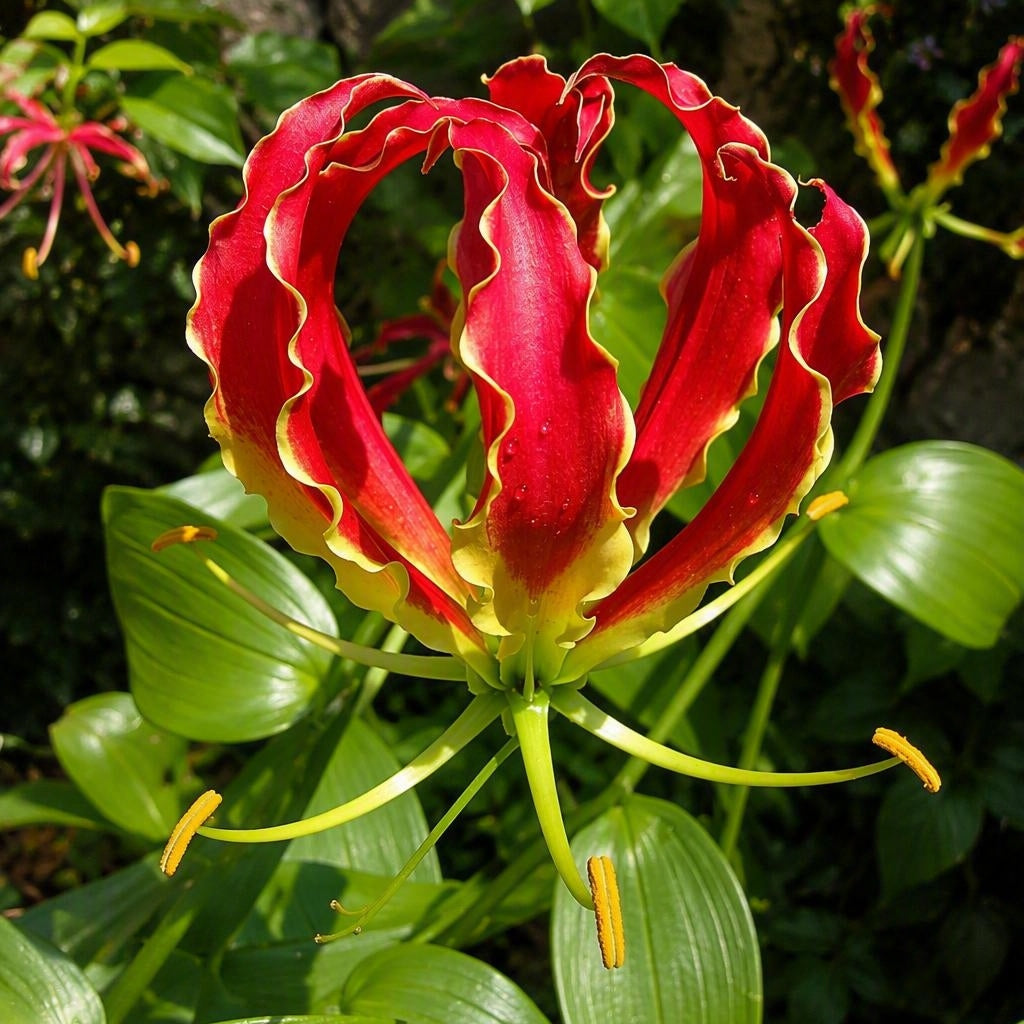

Gloriosa superba 'Rothschildiana' (Glory Lily, Fire Lily)
Gloriosa superba 'Rothschildiana' (Glory Lily, Fire Lily)
Couldn't load pickup availability
Gloriosa superba is a species of flowering plant in the family Colchicaceae. It is native to and common across most of Africa except North Africa, South Asia, Southeast Asia, and south-central China. It has been introduced to parts of Americas, Australia, and the Pacific Islands.
Unlike other plants, this plant produces green leaf-tip tendrils which are 5-7.5cm long, which is used for holding on to surfaces. The large solitary flowers measure 7.5-12cm long and 4.5-7 cm across.
The selection ‘Rothschildiana’ has wavy-edged, strongly reflexed bright red or scarlet tepals with yellow near the bases and along the margins, and bright green stamens. Named after Lionel Walter, the second Baron Rothschild, who reportedly first brought the species to Europe. L 3-4m
Warning ⚠️
https://en.wikipedia.org/wiki/Gloriosa_superba
The plant contains high levels of colchicine, an alkaloid, derived from the amino acids phenylalanine and tyrosine as precursors. Apart from colchicine and colchicoside, it contains several other alkaloids including gloriosine, chelidonic acid, and salicylic acid. The young leaves and seeds contain a higher concentration of colchicine, with the seeds containing a colchicine content that is two to five times higher than in the tuber. β-Sitosterol, a fatty acid, and glucosides are found in the flowers.
Due to the presence of colchicine, most parts of the plant are toxic, especially the seeds and the tubers. The plant parts or derived compounds are poisonous and ingestion can be fatal to humans, fish, cattle, and other domesticated animals. Poisonings also occur as the tubers are mistaken for sweet potato or yam and consumed. About 60 mg (0.93 gr) of colchicine is considered lethal to humans, while deaths have occurred at lower doses, and people have survived after ingesting doses of up to 350 mg (5.4 gr). Research has indicated that the median lethal dose was 5 mg per kg in rats.
In the Maldives the tubers are treated, sliced into thin chips and cooked in sugar to make a sweet delicacy.