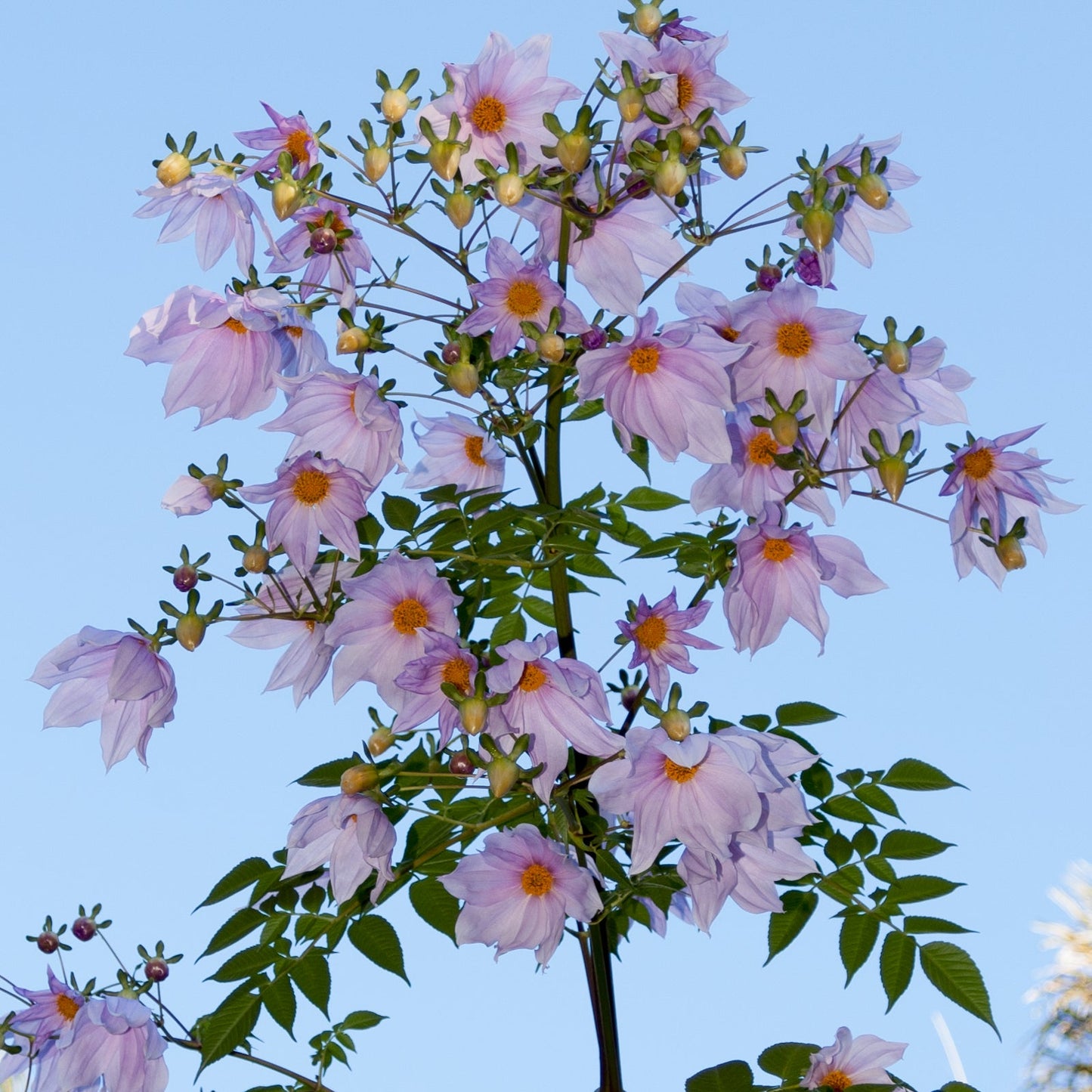
Dahlia imperialis (Tree Dahlia)
Dahlia imperialis (Tree Dahlia)
ASTERACEAE
Couldn't load pickup availability
Dahlia imperialis, or bell tree dahlia, is a flowering plant in the family Asteraceae that grows 8–10m tall in the wild. It is native to Mexico, Central America and Colombia. It is a plant of the uplands and mountains, occurring at elevations of 1,500–1,700m, and its leaves are used as a dietary supplement by the Q'eqchi' people of San Pedro Carchá in Alta Verapaz, Guatemala. H 8-10m x W 2-3m
Note: The PB40 specimen is quite large and heavy. It would be suitable for shipping during it's dormant period. Please contact us for options. Smaller plants will be available from Spring 2026 onward.
Dahlia imperialis (tree dahlia) is quite easy to propagate from stem cuttings. In New Zealand, spring to early summer is a good time, particularly once new shoots are actively growing.
INSTRUCTIONS FOR GROWING FROM CUTTINGS
Method 1: Detailed method
Optional: dip the base in rooting hormone (IBA). It isn't essential, but can improve consistency.
- Use a very free-draining medium (50% perlite + 50% coco coir or 70% perlite + 30% quality propagation mix)
- Insert 1–2 nodes below the surface
- Firm the medium gently around the stem
- Water thoroughly once
- Keep at approximately 18–25°C
- Bright light but no strong direct midday sun
- High humidity helps, but maintain ventilation to prevent fungal problems
- Keep the medium slightly moist, never saturated
Method 2: Easy method
- Insert the lower end of the cutting into any potting mix to about 1 or 2 nodes
- Keep moist and well watered
Method 3: Root in water
- Place the cuttings in a container of water with the lower 1-2 nodes below the water
- Keep the container in a sheltered area
It takes usually 2–4 weeks, although cooler conditions can make it longer. Gently tugging the cutting after about 3 weeks can indicate whether roots have formed—don't pull hard.
Once you see new growth and the cutting resists a gentle pull, transplant it into a small pot.
Share